How a battery management system is reverse engineered in four layers, from physical teardown to firmware, and what the findings are used for.
We don’t just tear down devices. We decode them.
In Electric Vehicle (EV) and grid-storage (also known as Energy Storage System, ESS) systems, the Battery Management System (BMS) is no longer a simple safety controller. It is the defining intelligence layer that determines safety, performance, reliability, and competitive advantage. While whitepapers and datasheets describe only the surface, the real innovation lies inside the production hardware and the embedded firmware. For details of the underlying principles of BMS architecture and associated reverse engineering please see our white paper on The Critical Role of Battery Management Systems in Electric Vehicles and Energy Storage.
This is where GHB Intellect’s effective reverse-engineering (RE) practice delivers real value. By dissecting real EV and ESS systems at the hardware, circuit, and firmware levels, we uncover how industry leaders actually design, implement, and protect their most advanced BMS technologies.
Our BMS reverse engineering supports original equipment manufacturers (OEMs), suppliers, investors, and litigators in their quest for:
- Competitive and technology benchmarking
- Intellectual property protection
- Evidence-of-Use (EoU) detection
- Safety and reliability evaluation
- Innovation scouting
- Battery model development and algorithm validation
Reverse engineering provides insights that cannot be obtained through documentation alone.
We’re one of the few organizations in the world that can perform this level of analysis in full (including BMS electronics, battery pack mechanics, and battery cell chemistry).
Here we will only focus on BMS electronics. For Battery cell chemistry analysis, please see Lithium-Ion Battery Innovations.
A four-layer framework for BMS reverse engineering
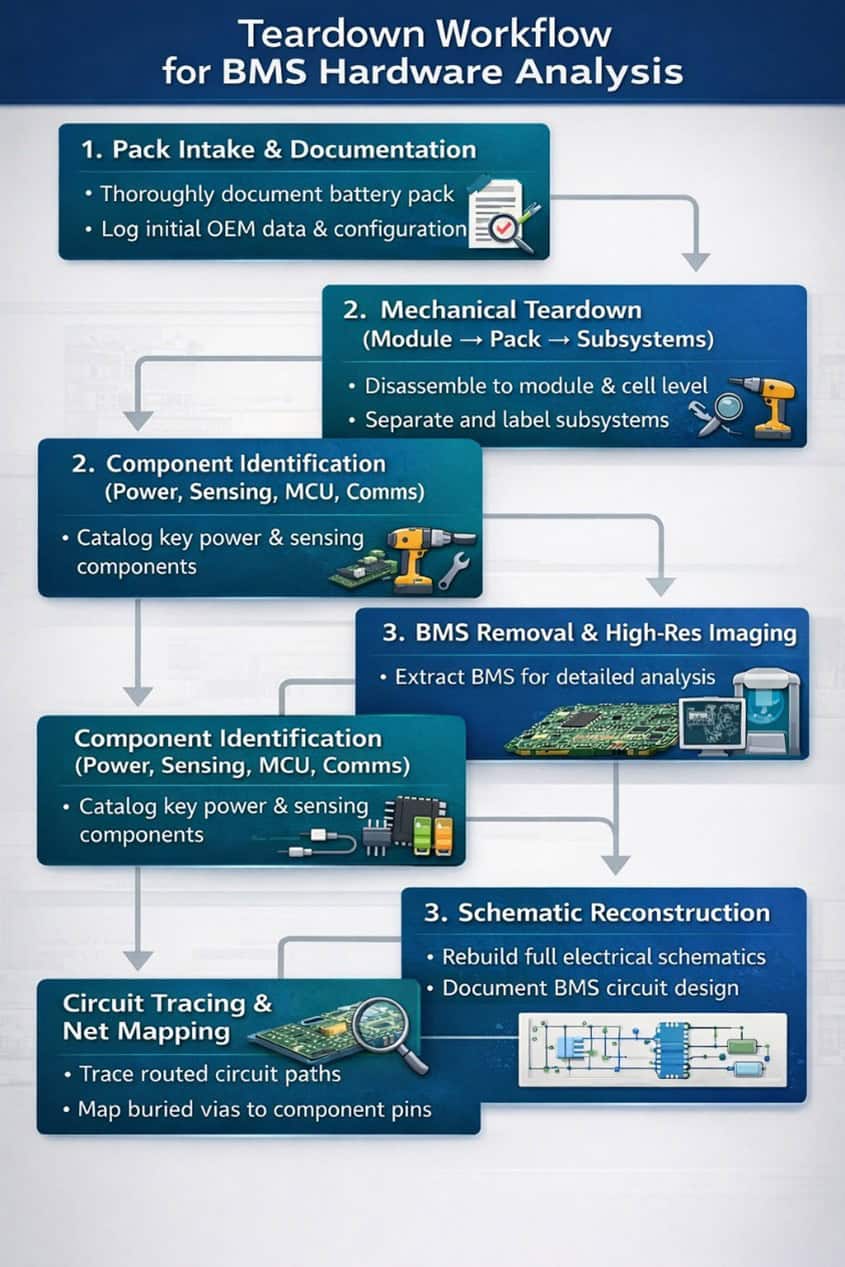
Our teardown and reverse engineering workflow combines engineering analysis, laboratory work by our engineers and qualified partner facilities, and real-world validation to produce a complete map of how a Battery Management System (BMS) is architected.
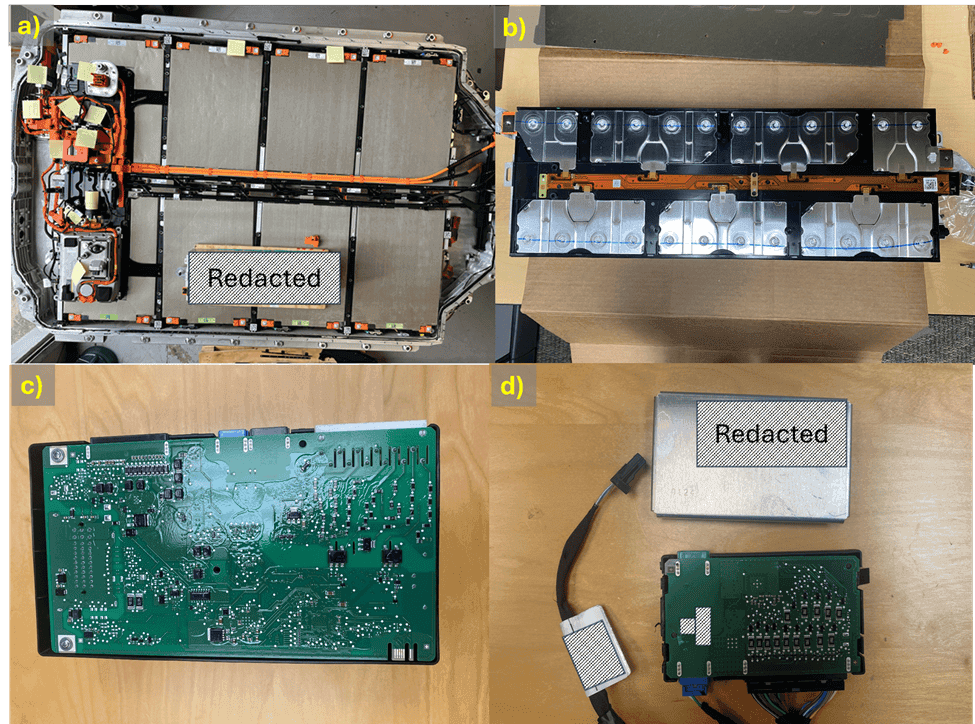
Physical teardown & component identification
The process begins with systematic disassembly of the battery pack:
- Pack opening and high-voltage isolation
- Module and cell extraction
- BMS controller removal
- Detailed imaging and component cataloging
- Identification of sensors, fuses, isolation devices, gate drivers, application-specific integrated circuits (ASICs), and microcontrollers
This phase reveals the OEM’s choices in safety architecture, sensing topology, power distribution, and internal redundancy.
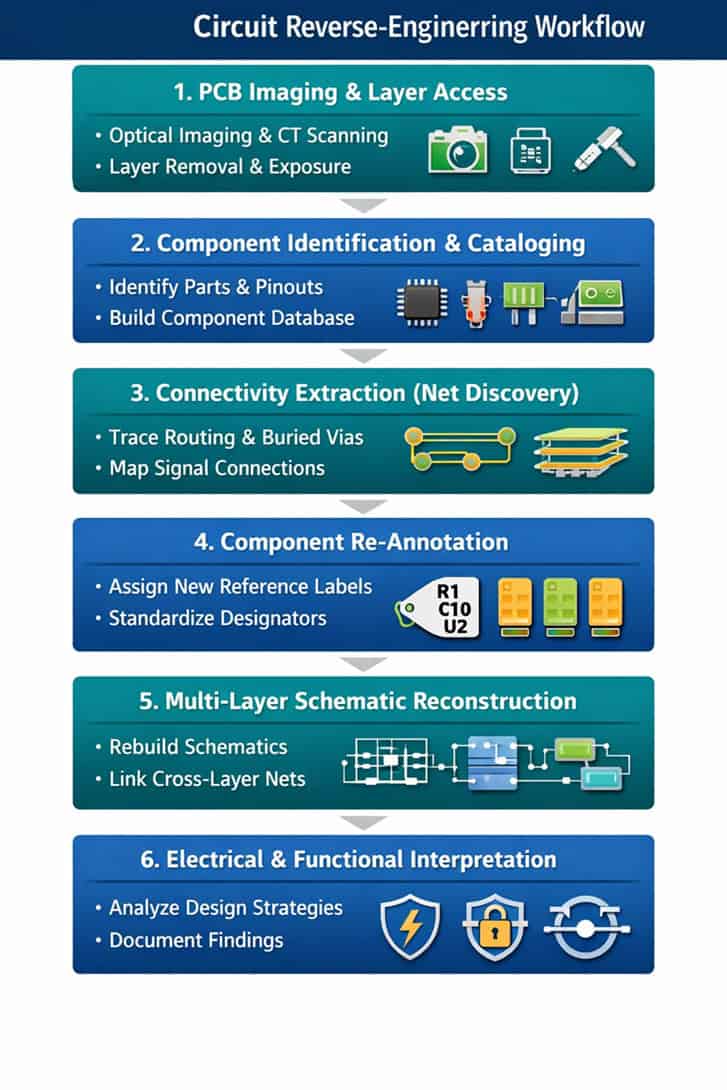
Circuit-level reverse engineering
Once the hardware is exposed, our engineers reconstruct the full electrical architecture of the BMS:
- Protection and contactor drive circuits
- Current and voltage sensing front-ends
- Passive/active balancing networks
- Isolation monitors and redundant safety channels
- High-side/low-side power management
- Controller Area Network / Local Interconnect Network (CAN/LIN) communication and wake-up circuitry
By reconstructing the full schematics and identifying every circuit connection and functional block, we reveal the OEM’s design philosophy, including strategies for noise immunity, fault tolerance, accuracy, balancing speed, and safety margins.
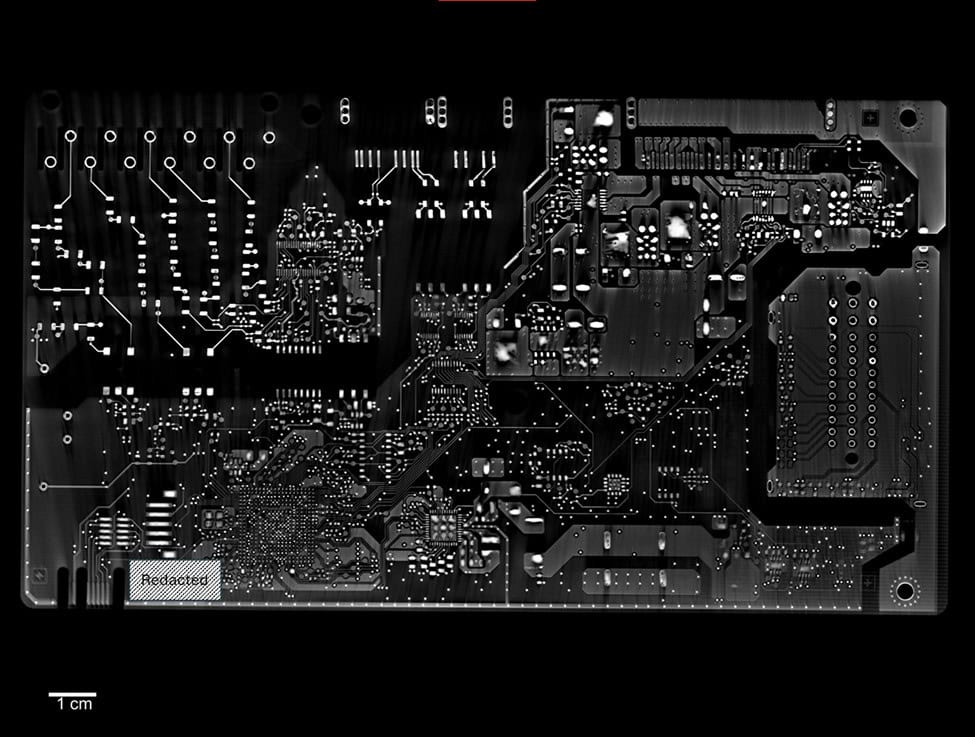
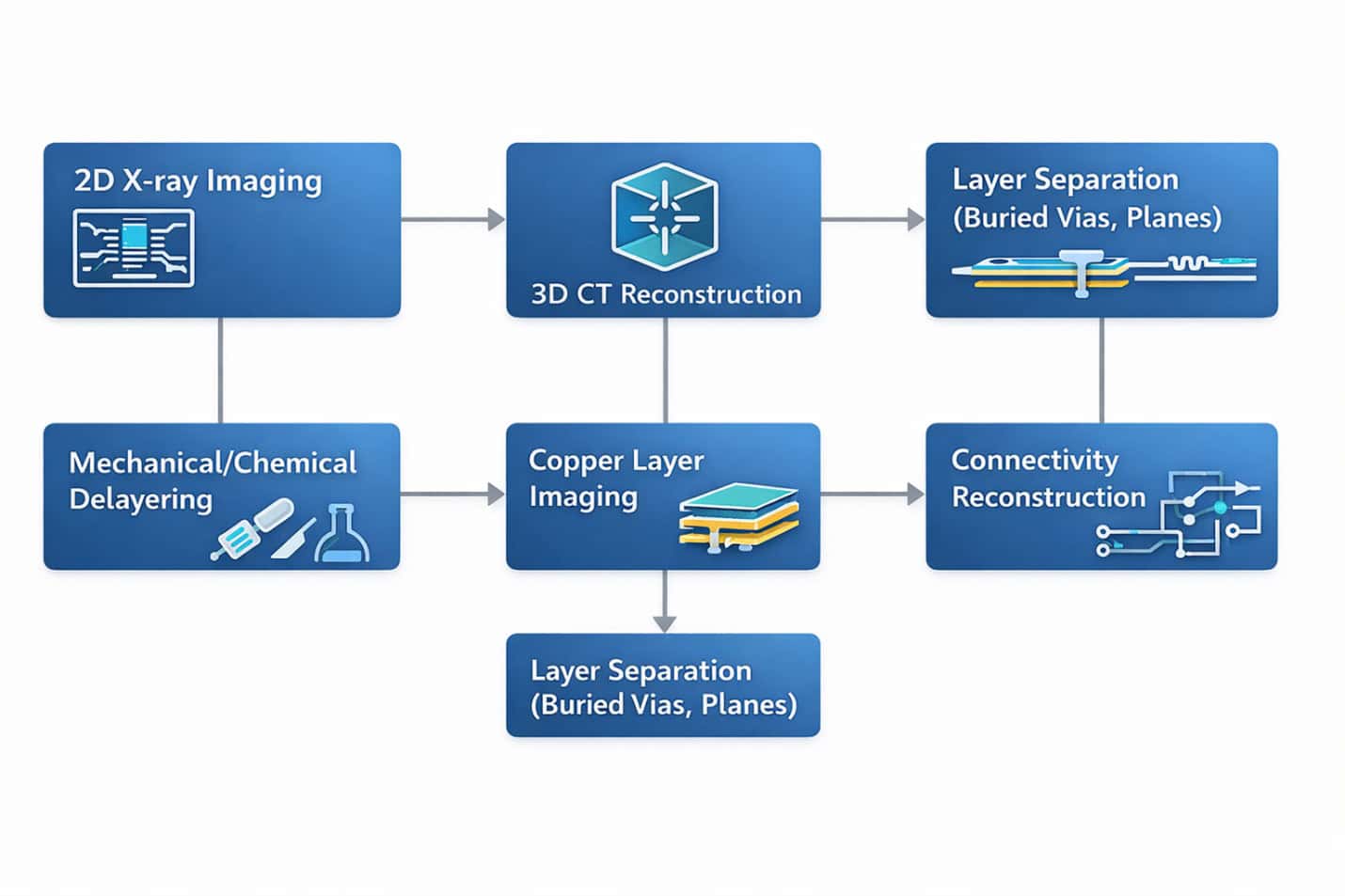
CT-Scanning & PCB delayering
Modern BMS printed circuit boards (PCBs) commonly feature:
- 4–12 layers
- Buried vias
- Segmented ground domains
- Dense analog and high-voltage routing
To reveal the hidden structure, GHB Intellect uses:
- 2D X-ray imaging
- High-resolution 3D computed tomography (CT) scanning
- Mechanical and/or chemical delayering
These analyses allow us to reconstruct every copper layer, inner-layer via, and trace pattern, producing a complete visual and electrical representation of the board.
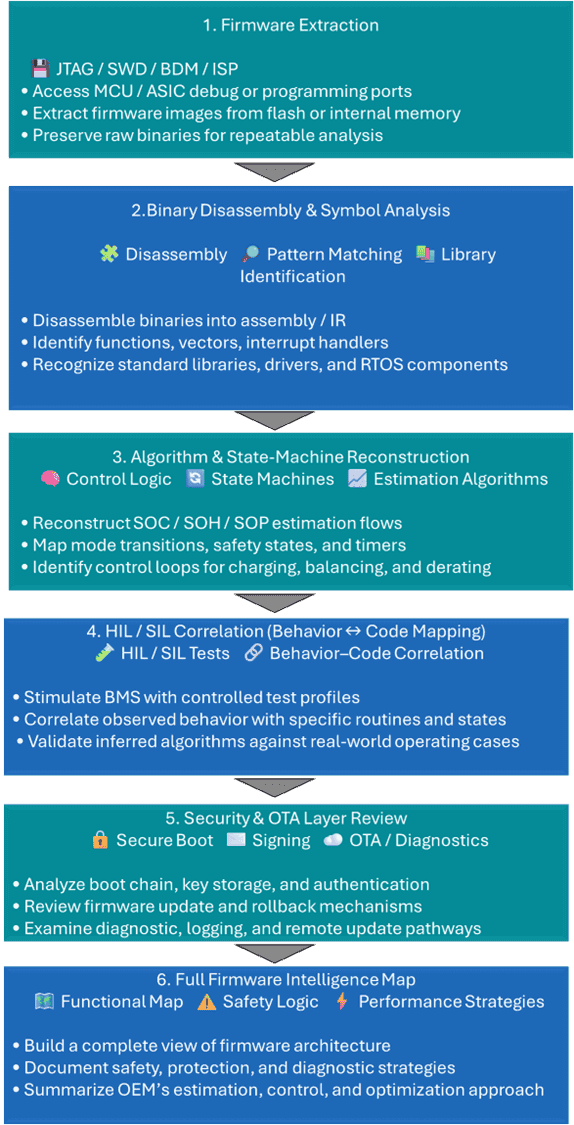
Firmware reverse engineering: exposing the algorithmic core
The heart of modern BMS intelligence is its firmware. It contains:
- State of charge, state of health, and state of power (SOC/SOH/SOP) estimation algorithms
- Kalman filtering and adaptive observers
- Fast-charging logic and derating behavior
- Thermal-management decision layers
- Fault detection, anomaly detection, and isolation routines
- Secure boot, over-the-air (OTA) update logic, and diagnostic handlers
We can perform:
- Firmware extraction (Joint Test Action Group/Serial Wire Debug/Background Debug Mode, diagnostic ports, chip-level methods)
- Binary disassembly and symbol analysis
- State-machine reconstruction
- Correlation with HIL (hardware-in-the-loop) testing
- Identification of algorithmic implementation of equivalent circuit model (ECM), electrochemical model (EM), electrochemical impedance spectroscopy (EIS), and machine learning (ML)-based models
This allows us to map the OEM’s complete algorithmic strategy, from sensing and filtering to safety enforcement and performance optimization.
Why BMS reverse engineering matters more than ever
Competitive benchmarking
OEMs invest heavily in BMS design. Reverse engineering (RE) reveals:
- How top EV makers balance safety vs. performance
- Proprietary balancing, sensing, and protection strategies
- The evolution of algorithms across generations
This intelligence supports strategic planning, research and development (R&D) road-mapping, and technology gap analysis.
Patent protection & evidence-of-use
GHB Intellect routinely supports patent litigation, licensing, and portfolio evaluation. Our RE work identifies:
- Circuit-level implementation of claimed inventions
- Firmware routines matching patented estimation logic
- System-level behaviors corresponding to patented methods
- Novel techniques worthy of new patents
This is indispensable for legal teams, patent owners, and licensors.
Safety and system assurance
Understanding how a BMS detects faults, handles wake-up and shutdown, manages contactors, and filters sensor noise is crucial for verifying:
- Compliance with ISO 26262
- Robustness under abnormal conditions
- Redundancy and fail-safe mechanisms
Technology scouting & M&A due diligence
For investors, suppliers, or OEMs evaluating partnerships or acquisitions, RE provides the clearest possible insight into the maturity and competitiveness of a company’s BMS technology.
Turning reverse engineering into actionable intelligence
GHB Intellect RE effort is designed to enable:
- Full schematic and PCB reconstructions
- Algorithm maps and firmware documentation
- Block-level architecture identification
- Identification of intellectual property (IP) and competitive differentiators
- Benchmarking EV/ESS platforms
- Actionable insights for R&D, legal, and business teams
These deliverables are used by:
- Automotive OEMs
- Battery developers
- BMS suppliers
- Legal teams
- Investors and analysts
- Energy storage integrators
Our multidisciplinary team of battery scientists, circuit designers, firmware analysts, and IP strategists ensures that every layer of the system is interpreted correctly and placed in context.
Why Choose GHB Intellect?
We’re well placed to investigate battery management systems (BMS) because we combine:
- Electrochemical expertise (nickel manganese cobalt NMC 811, lithium iron phosphate, lithium nickel manganese oxide, Si-blends) through our Battery Cell Characterization product
- Advanced materials analysis
- BMS architecture & control knowledge
- Circuit and PCB reconstruction capabilities
- Firmware reverse-engineering specialties
- Extensive expertise in patents, IP, and litigation support
These multi-disciplinary expertise and capabilities are necessary to not only document what exists, but also explain why it was designed that way, how it compares to the competition, and where opportunities exist for improvement or innovation.
If you’re developing next-generation EVs, battery modules, or energy-storage products, understanding real-world BMS design is essential. GHB Intellect can help you uncover the architecture, circuitry, algorithms, and IP that define market-leading systems. Contact us to learn how our BMS reverse engineering, technical intelligence, and advanced battery analysis can accelerate your R&D, strengthen your IP position, and give you a competitive edge. Connect with our team today to start your reverse-engineering engagement.
See GHB Intellect’s reverse engineering services, and the white paper on battery management systems.