What’s really inside the battery: testing Li-Ion cells in major phones and notebooks
A client needed to know whether the lithium-ion (Li-ion) batteries in several major smartphone and notebook products fell within specific voltage and capacity parameters. Two battery specialists designed and ran the tests, measuring each device’s charge cut-off voltage and harvesting electrodes to calculate the anode-to-cathode capacity ratio.
Case study · Testing and characterization · Batteries · Consumer electronics
The situation
- Products
- Batteries in several major smartphone and notebook products
- Questions
- Charge cut-off voltage and anode-to-cathode (N/P) capacity ratio
The client needed to show whether the batteries inside several major smartphones and notebooks fell within specific voltage and capacity parameters. Neither number is something a manufacturer typically publishes at that level of detail, so the answer had to come from the cells themselves.
The challenge
- Core difficulty
- Measuring cells in working devices, then taking them apart for the second test
- Requirement
- Repeatable results that could be compared product by product
The cut-off voltage is the point at which a battery is treated as fully discharged. Go further and the battery is likely to be damaged, which is why most devices shut themselves down when they reach it. Measuring it means watching the cell inside a working device through repeated charge and discharge cycles.
The N/P ratio, the capacity of the anode relative to the cathode, is a basic design choice for balanced, high-performance cells. It can only be measured by taking the cell apart and testing each electrode on its own.
What GHB Intellect did
- Team
- A senior Li-ion specialist with 30+ years in industry and academia, and a battery and energy storage specialist
- Instrumentation
- Voltage probes and a Bio-Logic potentiostat for data logging
- Method
- Repeated charge cycles in each device, then half-cell testing of harvested electrodes at C/20
The senior specialist reviewed the questions and designed the tests. The second specialist carried them out in an energy laboratory.
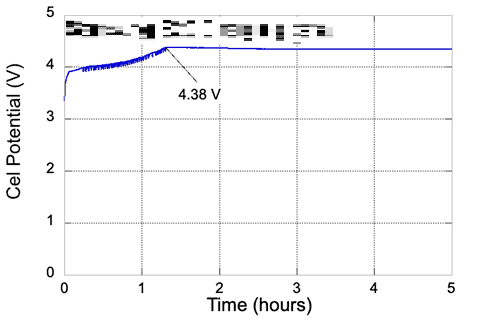
For the cut-off voltage, the team attached voltage probes to the battery terminals inside each host device and logged the cell voltage while it charged. The discharge and charge cycle was repeated several times per device, and the average cut-off voltage was calculated for each one.
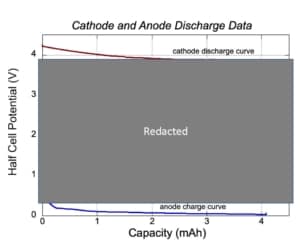
For the capacity ratio, the team harvested the anode and cathode from each cell and built them into half-cells of identical area against lithium metal counter electrodes. They measured the available capacity of each electrode at a C/20 rate across the full voltage range and computed the ratio.
Outcomes
- Cut-off voltage
- Calculated for each device, averaged over repeated cycles
- N/P ratio
- Calculated for the batteries in each product
- Result
- Both numbers, measured rather than estimated, for every product in scope
Figures
Related work
Technical assessment
An independent read on whether a technology works, scales, and is ready.
Teardown and competitive analysis
Analysis of a product at any level, from the mechanical design and electronics to the software and materials, for engineering or for evidence.
Claim charts and evidence of use
Evidence about what a product implements, mapped claim element by element.
Tell us what you need to know
A senior person replies within one business day. All inquiries are confidential.